Sleeping Mountains

Reflections on life, literature, and culture.

Tag: Germany

Phantom Earthquakes

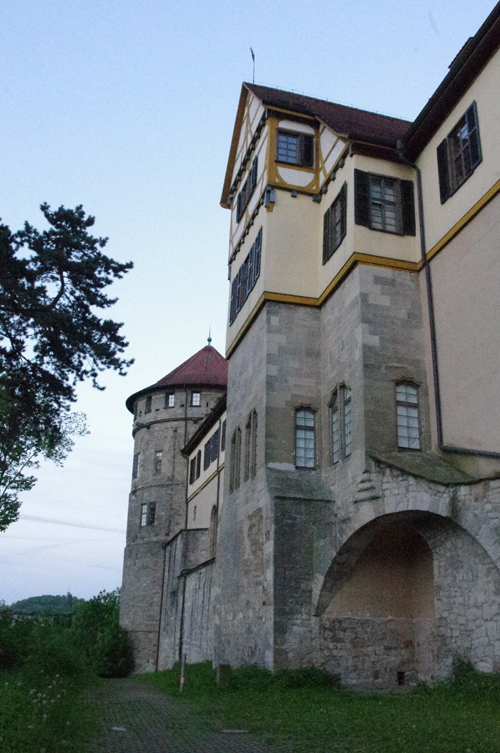
The castle of Tübingen, which was supposedly damaged in a 1970 earthquake.

It has been far, far too long since I wrote here! A lot has been changing and happening in the world around me. (I moved to southern Germany in March and began studying at the University of Tübingen here.) And with getting used to all the changes, I have not been able to find a perspective on things to be able to write anything interesting on the blog. But that state of affaires can’t last forever. Perspective eventually arises in the chaos, a focus will at some point be found. . . even if its interest dissipates within moments of its having been uttered. The following is about a strange sort of experience I’ve had a few times (so, repeatedly) since coming here.

In an attempt to keep some sort of continuity here, I’d like to address the issue that first comes to the minds of people here in Germany when they hear I recently moved from Japan. They all mention Fukushima. Having been directly affected by power outages and concerns about food contamination, there is certainly something of great concern that I can address in such conversations. It seems, however, that this issue hugely overshadows the destruction that the earthquake and the tsunami wrought. The 15,854 deaths and 3,155 people missing due to the latter have even been mis-attributed by some to the nuclear accident, where no deaths have occurred. Which was the greater disaster? Which still holds the greater threat?

I have no intention to make light of the 6 workers who have received doses of radiation higher than lifetime limits and more than 300 who have received significant radiation (Wikipedia). And the issue of human error (for  which cronyism among government, nuclear regulation, and journalism has been rightfully blamed) is more obvious in the case of Fukushima Dai-ichi, although human error lies also with building cities in areas likely to be flooded by tsunamis.

Many seem to think that the earthquake and tsunami were a natural disaster, which makes them unavoidable, unlike the human disaster at Fukushima. But centuries-old stone markers that can be found throughout the Tohoku region warn about the dangers of building homes in low-lying areas, but few heeded those warnings. If not a faith in technology, at the very least a faith in progress – faith that the present generations knows more than those past – led to heedlessness. Certainly, the blame for this error was not as convoluted or tied to centers of political power as the error at Fukushima, but it is fascinating how the earthquake and tsunami are seen as an almost non-issue here in Germany.

Why are the earthquake and tsunami a non-issue? Is it because, being natural, it is unavoidable? Or is it because older Germans have a clear memory of Chernobyl (memories of disasters, it is said, last for three generations), and the emotional intensity of such memories evoke greater concern? Can Germans not identify with feeling the ground shake or huge waves wash over the land? Germany, particularly the Rhine Valley and the Swabian Albs in the south, has a history of seismic activity, albeit hardly comparable to that of Japan. Along the North and Baltic Seas there is little seismic activity and no great quantity of water as in the Pacific that could cause much of a tsunami. Is it because Germans have never personally felt that fear that they don’t understand the destruction? Whatever that answer, however, it is not a lack of compassion for earthquake victims that I want to address. . .

Life in Germany seems to be, for the most part, without any threat to life in general. No major disaster might suddenly kill thousands. The last great war was two generations ago and education about its horrors make memories present enough to prevent a reoccurrence. The economic crisis may have had its effects (although limited in this part of Europe), but none life-threatening that I am aware of. And so little to nothing threatens to cut the lives of the general population short. Few people here could imagine the occasional fear that rips through me when the floor shakes before my own reason reassures me that it must be a household appliance of some sort or someone bouncing their leg during class and no more. They don’t see the people around them as the people they would have to cooperate with should a natural disaster strike or as the people they might die with.

But a lack of fear is, in this and in most cases, something to be desired. (I certainly would feel less silly if I didn’t feel these phantom earthquakes.) What might be of value, though, is the reason for fear and a thorough knowledge of transience, an eventual end to everything that we know and rely on. Such a knowledge brings with it an urgency in people’s actions, a consistency and reliability in creativity (in a wider sense that includes more than just art, but rather all of human activity). Such urgency in creativity, in turn, brings meaning to life, for meaning, as I understand it, is the constant search for and creation of meaning.

Happy Year of the Dragon!

(Fireworks as seen from our balcony in Tübingen.)

On my way to Germany in December, I flew through Shanghai, and a Chinese woman about my age sat next to me on the first leg of the journey from Tokyo. We found we had a lot of things in common. She has lived in Japan now a little longer than I have, she is a student in Tokyo like myself, and we were both on our way to spend the holidays with our families.

A more random commonality she and I shared was the cultural heritage of setting off fireworks at New Year’s. I remember the first night of a trip I once took to Shanghai years ago was the last night of the lunar Chinese New Year celebrations, and private citizens were setting off fireworks in the streets as I watched from our high rise hotel window. The same, my seat mate said, happens in China on the western calendrical New Year. And so, said I, at New Year’s in Germany, and she looked at me surprised.

So, here is a photo of some private fireworks I saw at midnight on January 1, 2012 from our balcony, which overlooks part of Tübingen, Germany. If it hadn’t been for the vigorously chiming bells throughout the city or the colorful stars bursting in the sky, the incessant explosions, shouts, and billowing gunpowder smoke throughout the city might have lead one to believe there were a war underway. Perhaps for the people setting of the fireworks, it was a moment of cathartic ecstasy. But I was so tired from staying up past midnight that I somehow fell asleep despite the ongoing blasts, hearing sirens through the haze of my encroaching dreams.

I wish you all a happy 2012!

Where is Home?

(The Ammergasse, an alley in the center of Tübingen with a small stream, the Ammer, flowing along one side. As kids, my sisters and I played Poohsticks on these bridges and all along the Ammer through the medieval city center.)

I recently returned to the town where my parents met, where I was born, and where I spent two years in school, the fourth grade in elementary school and the ninth grade in gymnasium. It was my first trip back to Germany in almost four years.

As a kid, I used to say that this town, Tübingen, was where I felt at home, but the town I spent more of my childhood, Salem, Oregon, was where my friends were. I had very few friends in Tübingen, but Salem as a city just didn’t hold my fancy. I wanted to go as far away as I could once I graduated high school. And that’s exactly what I did, going to the East coast for college and then moving to Japan after graduating there.

You might wonder why I didn’t go to Tübingen or at the very least study German language and literature like my sisters did. The answer to that is a bit more complex and would lead me far away from the question at hand, but simply put, I realized the world was larger than western Europe and North America, and I wanted to see something different. Or at least, that’s how I explained it to myself at the time. . .

So, I studied Japanese and came to Japan, first to Kyoto and then to Yokohama and Tokyo. And I’ve lived more years in Japan now than I ever lived in Germany, but that doesn’t make me Japanese. . . Those kinds of judgments make me smile. Due to my fascination with the cultural arts in Japan and particularly when I’ve worn kimono, Japanese have told me I’m more Japanese than they are. No, I’m not Japanese, although I find that compliment flattering.

Would a Japanese person want to learn their own culture from the inside out in the same way I did, by taking lessons in tea ceremony, kimono, calligraphy, and noh performance, and even then, still not satisfied, by going to university in that country to acquire a historical perspective of the cutlure? But more importantly, is being Japanese (or fully integrated, which is pretty much the same thing in this case) necessary to feel at home in Japan? I don’t think so.

So, why have I stayed in Japan so long, for most of my twenties? I can’t dispute the fact that personal relationships have played roles at certain times, but when they ended, I remained here. A certain drive to be able to show something for my struggles here was also a factor, but that’s not all. This place slowly became familiar to me, perhaps it grew to be a cultural home to compliment my other homes in the US and Germany. But these kinds of designations become clearest to me when I leave to go somewhere else. When I’m in Japan, I still feel somehow unsettled. I guess I’m not quite at home here yet, although I love this place.

Dilek Zaptcioglu, a Turkish author of German upbringing, said in a radio interview once that her friends of multiple nationalities ask each other, “Have you found your third country yet?” They go to Turkey or to Latin America in search of a third country, a country to call home. But in the end home is probably not a country, a culture, or a community, although these might have something to do with it. Instead, it is perhaps a deep feeling of contentment in the place one finds oneself or maybe it’s a feeling that one doesn’t have to fight for one’s own space.

Not that I know. I still haven’t found my home yet! Haha!

The adventure continues. . .

Tübingen Graffiti

(“What everybody considers agreed upon most deserves to be questioned.”)

Just a bit of graffiti on a wall in a small German university town paraphrasing a German 18th century scientist and philosopher, Georg Christoph Lichtenberg. No big deal, . . . but what a town of geeks! I love it!

The Reader

(My hat at the café.)

After a few cold, rainy days that marked the beginning of the rainy season this last week, today was beautifully sunny. After lathering on sunscreen, donning a pair of shorts and a hat, I set out, but made sure my bag was well stocked with reading material.

My goal was a café where I might spend the afternoon reading, but first intending a short stop at the university library to copy a text they have, I found the place suffering from a blackout. A librarian came to me outside the electric wickets at the door and said she could let me in, but all the lights were out. Well then, no way to make copies, I thought. But as I turned to leave, I realized the lights in the opposite building were on. That’s strange, I thought, turning back and seeing the library was blessed with lighting as well. So, my copying got done with only a moment’s delay.

Then, after browsing through a used book store near the station (and buying two Reclam for a price I would not later regret), I wandered along neighborhood streets to Shimokitazawa, a part of the city popular with college-age kids and full of quirky shops, cafes, casual restaurants, and strangely enough, an unusual plentitude of haberdasheries. After finding a bright spot near the window of an otherwise low-lit cafe that was permeated with jazz, I ordered myself a cup of coffee and started reading.

Once in a while, I would look out the window. A young cook came out a door on the first floor of the building across the alley, and carried a tray of Chinese food up some outdoor stairs that wrapped around the corner. He sat down on the stairs so I could just barely see his feet as he presumably ate his lunch.

Looking up again later, a middle aged man was on a third floor balcony of the same building, with his back to the building as he smoked staring straight ahead, his forehead creased and his eyes veiled as if he were thinking of something that had nothing to do with his current location. He shoved his cigarette stub into the large and well-populated ash tray and went back inside. But a little while later, I saw him there again, smoking another cigarette and standing in the same manner with the same look on his face.

Just before I left the cafe, after my second cup of spectacular coffee, I glanced up and saw the man there again, only this time he appeared to be looking in the window where I sat with that same stern gaze. Surprised at being caught looking at him and equally unsettled at having that gaze directed towards me, I turned back to my reading.

After leaving the café and on the train ride home, I pulled out one of the Reclam books I’d bought that afternoon, a collection of Rilke’s poetry. I read until I came to a poem that reflected the general mood of the day. I reread it, then read a few more before flipping the pages back to that poem to read it again.

Here it is. Scroll down for my (hasty) translation into English after the German original. Forgive me, for it is my first German-English translation of poetry, but I thought I would try after hearing a radio interview this morning, in which Brian Eno touched on the differences in musical structure from one language to the next. I intentionally disregarded the rhyme and switched around the word order only when it sounded too contrived, but please tell me if you have any suggestions for improvements! I will consider them.

I hope you like it.

Der Lesende

Ich las schon lang. Seit dieser Nachmittag,
mit Regen rauschend, an den Fenster lag.
Vom Winde draußen hörte ich nichts mehr:
mein Buch war schwer.
Ich sah ihm in die Blätter wie in Mienen,
die dunkel werden von Nachdenklichkeit,
und um mein Lesen staute sich die Zeit, –
Auf einmal sind die Seiten überschienen,
und statt der bangen Wortverworrenheit
steht: Abend, Abend . . . überall auf ihnen.
Ich schau noch nicht hinaus, und doch zerreißen
die langen Zeilen, und die Worte rollen
von ihren Fäden fort, wohin sie wollen . . .
Da weiß ich es: über den übervollen
glänzenden Gärten sind die Himmel weit;
die Sonne hat noch einmal kommen sollen. –
Und jetzt wird Sommernacht, soweit man sieht:
zu wenig Gruppen stellt sich das Verstreute,
dunkel, auf langen Wegen, gehn die Leute,
und seltsam weit, als ob es mehr bedeute,
hört man das Wenige, das noch geschieht.

Und wenn ich jetzt vom Buch die Augen hebe,
wird nichts befremdlich sein und alles groß.
Dort draußen ist, was ich hier drinnen lebe,
und hier und dort ist alles grenzenlos;
nur daß ich mich noch mehr damit verwebe,
wenn meine Blicke an die Dinge passen
und an die ernste Einfachheit der Massen –
da wächst die Erde über sich hinaus.
Den ganzen Himmel scheint sie zu umfassen:
der erste Stern ist wie das letzte Haus.

The Reader

I had read a while. Since this afternoon,
with rushing rain, had lain against the window.
Of the wind outside I heard no more:
my book was heavy.
I saw him in the pages as in faces
grown dark with contemplation,
and around my reading, time pooled. –
All at once the pages were lit over,
and instead of the word confusion
stood: evening, evening. . . all over them.
I have yet to look outside, and already
the long lines tear, and the words roll
from their threads to wherever they please. . .
There I know it: over the overfull
glimmering garden the heavens are wide;
the sun should have come once more. –
And now will be summer night as far as one can see:
too few groups form of the scattered,
dark, on long paths, stroll the people,
and strangely far off, as if to mean more,
can be heard the few things that still occur.

And when now I raise my eyes from the book,
nothing will be strange and all great.
Out there is what I live in here,
and there and here, all is boundless;
only that I am more interwoven in it,
when my gaze fits to the things
and in the masses’ earnest simplicity –
there the world grows beyond itself.
The whole heavens seem to contain them:
the first star is like the last house.

Follow

Get every new post delivered to your Inbox.