Sleeping Mountains

Reflections on life, literature, and culture.

Tag: Japan

Commentary: “Zen Groups Distressed by Accusations Against Teacher” New York Times

Joshu Sasaki

Joshu Sasaki in New Mexico in 2007. (via the New York Times)

On Monday, the New York Times reported on sexual misconduct by Joshu Sasaki, the now 105 year-old Rinzai Zen master born in Japan who has been teaching in California since 1962. The accusations include that he has “groped and sexually harassed female students for decades, taking advantage of their loyalty to a famously charismatic roshi, or master,” that he has invited female students to “sexually coercive” meetings and had affairs with students. Apparently, these activities have happened since at least the 1970s, but were not openly addressed by the community. In fact, these activities were condoned by other members of the community, and allegations by female members were condemned by some male colleagues, because they sullied the master’s reputation.

For some, it might be easy to lump this sort of activity with the sexual misconduct of Catholic priests. For others, the fact that the Zen master targeted grown women and not underaged children makes all the difference. And particularly those who are familiar with Buddhist practice or Buddhist thought will claim there is no comparison, because the Buddhist teaching has no such preoccupation with sex as is found in Christian doctrine. Celibacy is not necessarily required of Buddhist monks and nuns. However, even the lay precepts do not sanction sexual misconduct.

Nevertheless, this Zen master has engaged in inappropriate behavior for at least 40 years in the US. Why is the media interested now and not earlier? The New York Times article includes the argument that

“Because of their long history with Zen practice, people in Japan have some skepticism about priests,” Ms. Schireson said. But in the United States many proponents have a “devotion to the guru or the teacher in a way that could repress our common sense and emotional intelligence.”

Certainly, many if not most Zen priests in Japan are not celibate, but generally have families, which might make them seem more engaged with everyday society. In contrast, it seems like non-Japanese students in general seek a way to be released from the trials of everyday life and readily believe in the Zen masters who promise to help them in that pursuit.

The method a Zen master offers, though, is a similar method to that of any Japanese practice. Practice, known as shugyō in Japanese, is a process of practical training that is based on a direct engagement with the world. In Zen practice, zazen, or sitting meditation, is a fundamental element of this practical training. Thus, Zen is not a means of escaping the world, but a method of engaging with the world.

My experience with Japanese practice comes from five years of  lessons and four years of tea ceremony lessons—and hardly from the few times I engaged in sitting meditation. But the practical nature of training in the Japanese arts has similarities with Zen training.

Masters teach by example and through repetition instead of with explanations. A student is expected to learn by doing and by following the master’s example. The master will chose the lessons or situations a student must engage in, be the lesson a kōan to be contemplated in meditation, a nō dance, or a particular form of the tea ceremony. Each is its own form of challenge, which when overcome can lead to its own form of insight.

Furthermore, I have always been a student and never a master nor anything but a green beginner, and as such, it is clear to me that I will never change the centuries old institutions that have preserved these traditions and that support the masters who guide these practices. What I am contemplating here is thus not how the institutions must change, but what a student gains by taking responsibility for her actions and taking control of a situation she perceives as negative.

In a lesson, when training does not progress as the master expects, verbal and even physical intervention is common. For example, in nō, a teacher will correct a student’s posture by moving the student’s foot at the correct tempo, or in tea ceremony, a teacher will correct a student’s placement of an object by physically moving the arm into the right place. In Zen meditation, students may be hit with a stick called a keisaku to improve their concentration. (From my single experience of such a strike, because I was hit quite hard, I would say it is not painful when done correctly.) The physicality of the relationship between master and student may provide more opportunities for sexual misconduct, but it is not an inevitable outcome of such physicality.

It seems to me that the problem with sexual misconduct or harassment in Japanese practice is that practitioners might lump it together in their understanding of all negative experiences. Any experience—and particularly an experience that is initially considered uncomfortable or negative—is seen as a moment where learning may occur. Certainly, facing our fears and the boundaries of our comfort zones is the best way to overcome them. Also, the greatest creativity and the greatest insight come out of the greatest conflict. In practice, the masters who lead students’ training have the power of controlling the artificial creation of such experiences.

However, if a student believes that only her master can guide her to insight or enlightenment, not only does she make herself subservient—and therefore vulnerable to sexual harassment or other abuse—but she will never find the insight she seeks. A master can never achieve enlightenment for a student. In fact, oftentimes the teacher has no understanding what a student has learned or what she wishes to achieve in her life. A student must always remain aware of these things herself even as she turns to her master for guidance.

If a master should misuse that power as guide, the student always has the freedom to leave. In discussing the New York Time’s article, a friend of mine asked the question, what about those who don’t find the strength to leave? That, I agree, is the greatest problem. But some students decide to tolerate uncomfortable situations, because they expect to achieve something greater by enduring them. As one woman in Joshu Sasaki’s community told the New York Times,

“Outside the sexual things that happened,” the woman now in San Francisco said, “my relationship with him was one of the most important I have had with anyone.”

The article ends with a quote from a monk in the same community elaborating on that tension:

“What’s important and is overlooked is that, besides this aspect, Roshi was a commanding and inspiring figure using Buddhist practice to help thousands find more peace, clarity and happiness in their own lives. It seems to be the kind of thing that, you get the person as a whole, good and bad, just like you marry somebody and you get their strengths and wonderful qualities as well as their weaknesses.”

But if a student decides to leave that inspiring person, if she decides she does not need to subjugate herself to further abuse, she takes mastership over herself. Of course, the trauma—the memory of past abuse—does not go away when she leaves, but by leaving, she takes back her own responsibility for herself, body and soul. In the act of leaving, she learns that she can create her own life, which is perhaps the greatest insight.

A few questions remain in the end: How long does it take to learn to rely on one’s own power? And should students in such master-student relationships be reminded of their freedom to leave, whether or not misconduct occurs? How much would such a reminder change a situation if a student thinks she may learn something by staying and tolerating abuse?

Cited:

Oppenheimer, Mark and Ian Lovett. “Zen Groups Distressed by Accusations Against Techer” New York Times 11 February 2013. (link)

The Limits of Perfectionism

(Protests in front of the Parliament in Tokyo on June 29. Source unclear.)

For the first time in 40 years, Japanese are taking to the streets in such numbers that they cannot be ignored. On June 29, 20,000 to 45,000 (Japan Times and NYT). On July 8, music celebrity Sakamoto Ryoichi hosted a music festival that included many mainstream musicians (publicity site), On July 16, Sakamoto Ryoichi was again present at a rally where nobel laureat Oe Kenzaburo spoke to about 170,000 protesters assembled in Yoyogi Park (Asahi and NYT). And again on July 29, protestors broke through police barriers and successfully surrounded the parliament building in Tokyo in a candlelight vigil (Reuters).

Following the disaster at Fukushima, all Japanese nuclear power plants were shut down on May 5th this spring, but even then it was already announced that the Ooi Nuclear Plant would be reactivated to supply electricity to the Kansai region during the summer. At the time, the Japan Times reported that

[T]he government and power companies also have to win approval in the court of public opinion. . . (Japan Times, May 6)

and

Local government leaders near the plant, including the governors of Kyoto and Shiga prefectures and the mayor of Osaka, are reluctant to agree to any restart.(Japan Times, May 6)

As the announced day of the reactivation neared, public opinion found an outlet in a major demonstration in front of parliament on June 29th. Considering the general absence of protest and of civil disobedience of any sort in Japan since the student movements in 1970, the scale of these protests indicates a major change in the population’s tolerance of political developments. [Update on Aug. 5: The people choosing to engage in the protests have been previously unable to find conventional means of expressing their dissatisfaction. Their protest is against nuclear power, but as such they are acting against formal conventions and questioning the status quo.]

It seems to me that Japanese people have lost faith in their nation’s own ability to adapt and improve upon foreign technology. They are very much aware that it has been proven impossible to adapt technology for nuclear power to suit their own natural environment. Since the beginning of recorded Japanese history, they have prided themselves in their ability to learn from foreign cultures and technologies and then to perfect the foreign models by applying a meticulous attention to detail. That perfectionism has reached a limit in its capabilities.

Despite this obvious misjudgment of ability, plans to reactivate the Ooi plant continued due to threats of power shortages in the summer.

After recognizing power shortages were likely to occur this summer, governors and mayors in western Japan backed off from their earlier opposition in late May, and the Union of Kansai Governments effectively gave consent for the reactivation. (Mainichi,  July 2)

There are obvious limits to Japanese perfectionism, but they seem to be ignored by politicians. The government plods along as planned despite a large negative reaction from the general population. A strong dependence on formal procedure and precedent has made the Japanese government incapable of reacting to new circumstances. The politicians’ goal seems to be to maintain the status quo—to keep the electricity flowing despite the dissent. Their focus is not on fundamental problems, but on maintaining appearances. Has Japanese perfectionism become a mere show, an illusion that covers up an underlying fracture?

The government’s actions seem to reflect a formalization in Japanese society that has progressed to a point of near paralysis. Just as the government functions on precedent and formality, so too does the rest of Japanese society, including business and education in all its iterations. Does Japanese formality and hierarchy require rethinking? Might that not threaten to destroy Japanese society as we know and love it?

Of course, these questions are not new. They have been begging to be answered since the beginning of the economic downturn. Alex Kerr’s book Dogs and Demons reveals exactly these fundamental problems. But now they are more explicit and made present in a palpable fear of nuclear fallout among the general population.

In short, a major component of the Japanese “identity” is being publicly questioned. It seems as if Japanese dependence on formal structures is threatening to strangle the freedom necessary to adapt to any given situation. If Japan wants to overcome this threat to their own definition of self, they must rise to meet it. Formality and precedent must be questioned in order to create a balance with creativity. This balancing act is not impossible, but it is difficult to achieve. It will need all the care and attention (a different kind of perfectionism, perhaps) the Japanese are so famous for.

(Thanks to a talk on June 19 by philosopher Yamaguchi Ichiro in Tübingen for problematizing Japanese formality and hierarchy in post-Fukushima Japan.)

Japanese Group Mentality?

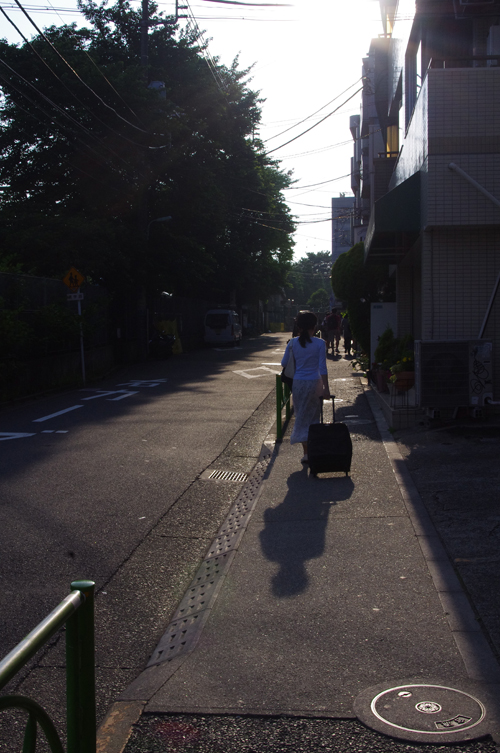
(Shibuya station of the Inogashira Line on an evening in May 2011.)

One often mentioned cultural characteristic (a stereotype, plainly put) that has been so deeply impressed into theories of Japanese culture is Japan’s so-called “group mentality.” This theory might have become something of a non-issue in Japanese cultural studies of late (except perhaps for scholars of “Nihonjinron,” theories of Japanese uniqueness from a rather Japanese perspective), but it is still perpetuated by international journalism, Western expats living in Japan, and many Japanese nationals, who are also considered experts on the issue. As long as this stereotype is so widespread, I think it requires a closer look.

The standard reason given for the Japanese group mentality is Japan’s tradition of rice agriculture, where close, careful relationships among community members were necessary to ensure the fair division of water resources even when they were scarce. The community, it is said, had to set personal differences aside to survive. But, large parts of Japanese society (fishing communities and the often low-class, mobile groups of society, for example) were never really tied to rice agriculture. It might be argued that these communities were not involved in determining the dominant culture. Do any of these types of social structures actually still influence the fabric of Japanese society today after agriculture has become such an industrialized industry that fewer and fewer people are a part of it and more and more people move to urban areas?

If the memories of major natural disasters persist for no more than three generations, what about major impacts on society that have a far less traumatic impact on most members? The recent major shift from agricultural to urban lifestyles in Japan happened in large part one or two generations ago. Those who started living in urban areas were not those negatively affected by the change. They felt little to no trauma (although there was likely some trauma among those left behind in rural areas). Few people I met in Tokyo ever spoke of agricultural roots. (I met a few more people with rural ties in Kyoto, but I guess I’m focusing on Tokyo culture in this post.)

Certainly, urban, corporate culture has also been changing within the last generation, from conservative models of group structure and hierarchy and so forth to more flexible, smaller, and independent forms of business. This, of course, is only an impression I have after working in a small, newly established company for a while and from friends who are young, creative people in Tokyo. But even among this young generation, there is a kind of group mentality that has grown within the last year.

Even during the earthquake a year ago, Twitter and cell phones connected my community of friends, many students, independent young entrepreneurs, and creative types. One friend called us all “single” people, a bit of an exaggeration if understood in a purely romantic sense. A few have significant others, but these people live relatively free of regulative social institutions. Most of them live alone, have self-delegated schedules, and are critical of conservative family, business, and other social institutions. In that sense, these people are all “single,” independent, and even individualistic.

Despite their perhaps unconventional situations and world-views, these young people formed a community in the weeks following the earthquake. Over our phones, we kept tabs on one another’s whereabouts and needs, and on one another’s mental shape as the death toll rose, aftershocks continued, and more cryptic news stories came from Fukushima. Having collectively looked into the face of our own mortality, we suddenly shared something few other communities share.

And this sense of community went beyond the people represented by entries in my cell-phone address book. Another friend tweeted at that time, she now saw the people around her as she navigated Tokyo as potential teammates, people she would have to cooperate with in the next earthquake.

So, if Japanese society may be charged with having a group mentality, it is not for any historical development from rice agriculture. It is a shared awareness of our own transient nature shaped by a common experience. This is not so very different, perhaps, from the effects of natural disasters on the cultures of other communities throughout the world. But it is very different from the respective cultures of people who see death as something one meets very much alone. . .

A Story of Japan’s Working Poor

Watched this yesterday and was reminded of many experiences:

If you find the time to watch this, I’d love to hear your comments.

Hirozawa Lake

(Hirozawaike, a lake near Arashiyama with views of the western mountains of Kyoto, at the beginning of September.)

I have posted about the yearly Horinji performance on September 9th (9/9) to mark Choyo and celebrated with chrysanthemums and chrysanthemum sake a number of times before. It feels like an end-of-summer ritual to me.

After the performance, my noh teacher’s students join him for the summer’s last Uji kintoki (delicate shaved ice with green tea flavoring and a dollop of sweet azuki) at an outdoor cafe at the edge of Hirozawaike. This year was no different, and just before we left in the late afternoon, I took the picture above.

Now a little more than a month later, it already seems so long ago.

Follow

Get every new post delivered to your Inbox.